Ryo’s journal · Food & perspective
The dish you love. A reason to visit.
Your restaurant’s next idea may already be on the menu.
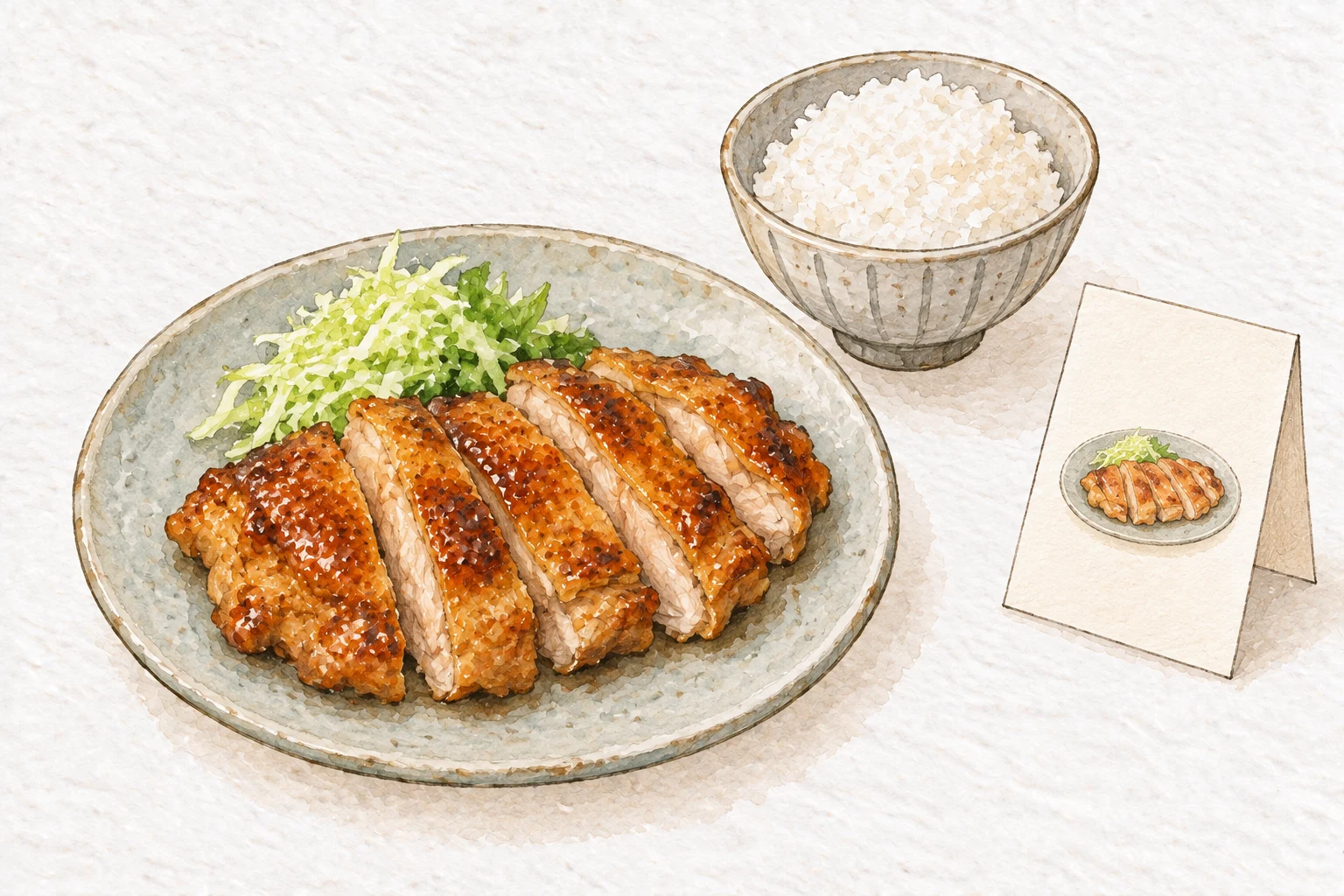
“I wish more people would try this.”
Perhaps it is a dish your regulars love, but newcomers rarely choose. Or a small detail you take care over every day, without ever mentioning it on the menu.
That is where I would like to begin. Not by making your restaurant into somewhere else, but by helping people discover what is already worth finding.
What if your teriyaki chicken became a reason to visit?
Imagine the teriyaki chicken you already serve. What makes it yours?
Is it the crisp skin? A house sauce you have kept refining? The satisfying way it comes together with a mouthful of rice?
My first question would be simple: “What do you love about this dish?”
If your answer is the crisp skin, perhaps we let more of that browned surface show instead of hiding it beneath sauce. A different angle for the cut pieces might make that detail easier to see.
The photograph and menu description can then draw attention to the same thing. A line such as “Chicken with golden, crisp skin and our house-made teriyaki sauce” could help—provided it matches the way you actually cook and serve it.
Someone may go from seeing “a place that serves chicken” to thinking, “I want to try that teriyaki chicken.” That is the possibility I want to explore with you.
The point is not simply to make a dish look more elaborate. It is to make the good part easier to discover.
A life shaped by food in Japan and beyond
My roots are in Fukuoka, in Kyushu—a region rich in Japan’s food traditions and ingredients.
I was born in Japan and spent part of my childhood in Perth and Sydney, Australia. During my student years, short stays took me to Sydney, Cairns and the Gold Coast, as well as Hawaii, New Caledonia, Italy, Germany, Finland and Vancouver. Encountering local food was part of encountering each place.
That is the combination I want to bring to our work: a personal connection to food in Japan, and curiosity about how it feels to someone somewhere else.
A Japanese approach to cooking a local vegetable. A hint of the season in the colors of a plate. A familiar dish that tells a different story through the vessel it arrives in.
Fukuoka is my starting point, not the edge of my interest. I look across Japan for ideas that might find a meaningful place at your table.
I do not want to impose a Japanese template on a restaurant with its own guests and identity. I want to find connections that make sense there.
And I want those connections to be honest. Taking inspiration from Japan is not the same as using ingredients sourced from Japan. Neither needs to pretend to be the other.
A good idea must work on a busy day
“That sounds interesting. But who is going to prepare it?”
It is a fair question, especially when you cook and serve on your own. An extra garnish can mean preparation, storage and washing-up. A longer introduction can keep you away from the next order.
Before suggesting more, I would ask how many people are available and where the day already feels full. The same question matters whether you work alone, with a few people or with a larger team.
Perhaps the useful change can be made with ingredients you already prepare and plates you already have. Perhaps the dish itself does not need changing at all; a clearer description and a more thoughtful photograph may be the place to begin.
A small restaurant has room for the owner’s taste to come through directly. That is something to work with, not something to replace.
The aim is an idea you are excited to try—and can realistically keep using.
Let the experience begin before the guest arrives
A photograph catches someone’s eye on social media. They find the restaurant on a map and visit its website to see the menu and get a feel for the place.
Those moments can build anticipation before an order is ever placed.
Think back to the teriyaki chicken. The photograph makes someone curious. A short description tells them what to look forward to. Clear opening hours and directions help them plan a visit. Then the real dish arrives.
That is why UMACA works across food and websites. I want the story outside the restaurant and the experience inside it to belong together.
Outside, give someone a reason to visit. Inside, let the meal live up to that invitation.
We can start with a photograph of one dish
You do not need a grand proposal to begin.
“I want more people to know about this dish.”
“Our website doesn’t really show what makes us special.”
“I want to try something new, but it has to work with the people we have.”
A few lines like these are enough for a first conversation. A photograph of the dish can help, too.
From there, we agree on a focused piece of work. That could be plating ideas and menu wording for one existing dish, or a website that introduces the restaurant more clearly. The work and what you receive stay within an agreed scope.
If we begin remotely, photographs can show me the presentation, but they cannot tell me how the food tastes. Your tasting notes and trials in your kitchen are part of developing an idea that works. Any visit or in-person tasting would be arranged separately.
You know your kitchen and your local guests. I bring a perspective from Japan and ideas for what we might try together.
The goal is not a copy of a famous restaurant. It is a restaurant you feel proud to introduce: “This is us.”
Which dish in your restaurant deserves to be better known? Start by telling me what you love about it.