Ryo’s journal · Food & perspective
The same food.
A different experience.
What a meal can suggest,
before anyone takes a bite.
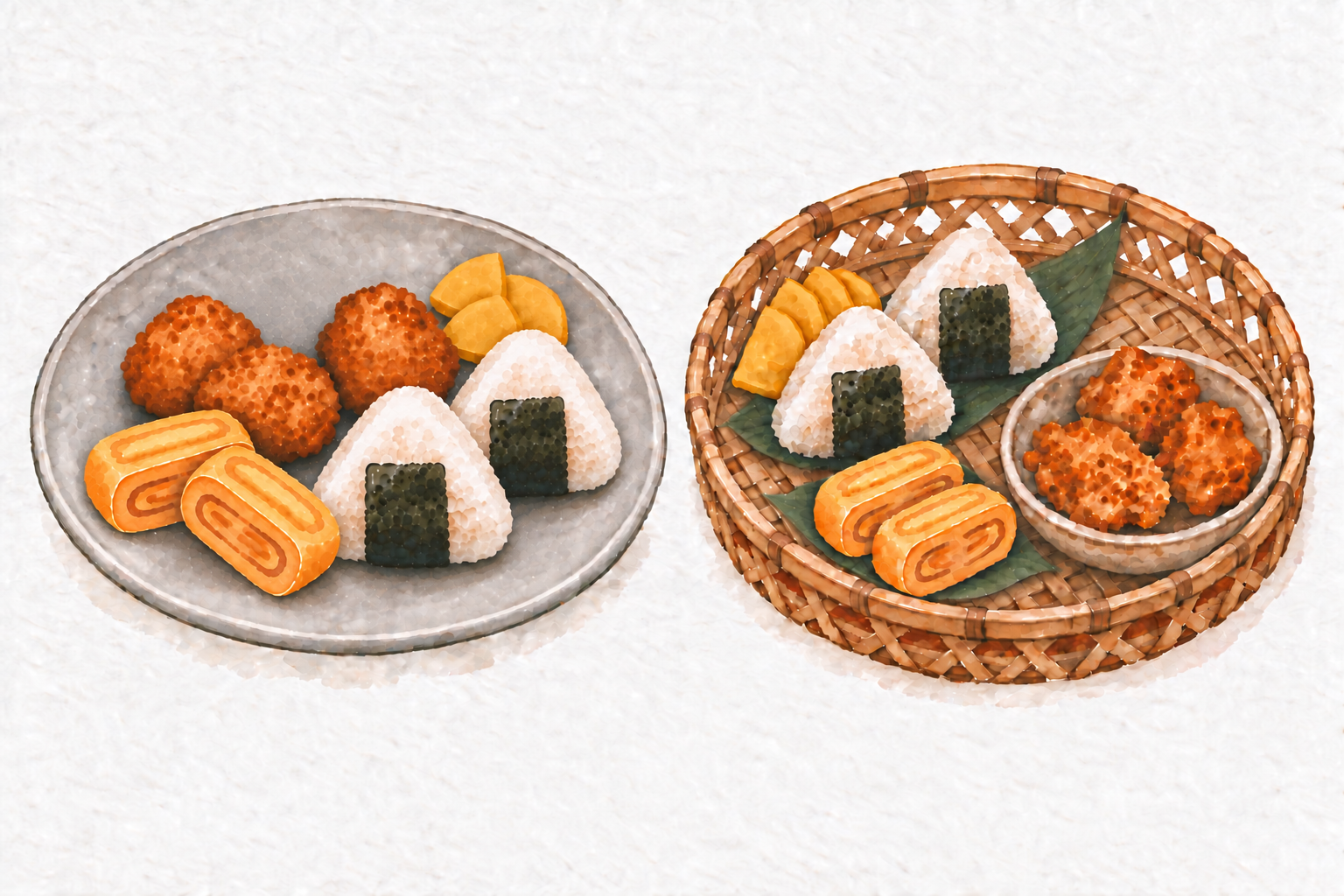
Rice balls, Japanese fried chicken, a rolled omelette, and pickled daikon.
There is plenty to enjoy in that simple combination. Picture it placed casually on a ceramic platter: an everyday lunch, without much thought given to the arrangement.
Now keep the food and portions the same, and change the setting. Arrange them thoughtfully in a shallow bamboo serving basket with a woven base, a small ceramic bowl and a few carefully placed green leaves.
The white of the rice. The yellow of the omelette. The golden chicken. A touch of green, considered spacing and the texture of bamboo. The same menu begins to suggest a different occasion.
For me, it might suggest a meal someone has prepared near the rice fields of rural Japan.
The menu has not changed. What has changed is the set of clues surrounding it. The basket is not inherently better than the plate; it tells a different story. The question is which story belongs in your restaurant.
01 · The setting
What lies beyond the plate?
When I think about a dish, I think about its flavor—and what it might bring to mind.
Not only a landscape. A family table. A slow morning on a day off. The moment an unfamiliar aroma reaches you in a restaurant you have never visited before.
The clue might be the material of a bowl, the act of sharing, a pause to watch the steam, or the sound of the first bite.
Think of drawing a face in ketchup on omurice, an omelette wrapped around rice. There is a small piece of play in finishing the dish yourself. Draw it with someone else, and that shared moment becomes part of the meal too.
That is what interests me about food experienced through the senses. Less a checklist of effects; more a relationship between the person and the meal.
02 · A feeling
Unfamiliar, yet somehow welcoming
A guest who has never been to Japan may not see rice fields in a bamboo basket. I would not expect them to.
But perhaps something else can travel: the feeling that someone has taken care in preparing a meal for you.
Something you have never eaten before that puts you at ease. Food from an unfamiliar place that somehow feels welcoming.
Those are encounters I would like to create through Japanese food.
The guest does not have to follow my story. One person might imagine the countryside; another might remember a family picnic. Someone else may simply enjoy the basket. There should be room for all of those responses.
Not every dish needs
to feel like a memory.
03 · Discovery
There is room for surprise, too
A familiar ingredient can introduce an unexpected aroma. A bite can have a texture you did not anticipate. A small finishing gesture can make something you know feel new.
I am equally interested in the meal that makes someone think, “I didn't know Japanese food could be like this.”
Do we want the moment to feel restful? To start a conversation? To invite a discovery? The food, vessel, and way of serving it should follow that intention.
04 · In practice
It has to belong in the restaurant
If we were developing this basket meal for a restaurant, a beautiful photograph would only be the beginning.
Would the arrangement be comfortable to eat from? Is the serving ware suitable for food, practical to clean and store, and available in the quantities the restaurant needs? Can the presentation work during a busy service, including when the same person cooks and serves? And on what occasion would the restaurant's guests want to order it?
I would start with one dish you already make well, for one occasion: a relaxed lunch, for example. Before service, keep the recipe and portion consistent while trying two presentations, on your own or with colleagues. Start with the serving ware you already have. Exploring this idea does not require buying a basket; changing the spacing on an existing plate may be enough to test a direction. Compare how it looks, how easily it can be eaten, and how the food holds up on its way to the table.
Before introducing it more widely, I would track plating time, serving-ware cost and breakage, cleaning and storage needs, and guest response during a small trial. A more elaborate vessel is not a reason to raise the price on its own. Any change has to make sense for the guest and for the restaurant's costs.
The menu description and the photograph on the website also shape the expectation of that meal. I want to consider whether the experience at the table delivers on that expectation.
A chef's work does not need to be painted over to give it a new direction. Sometimes there is something valuable in an existing dish that has not yet been made visible.
At UMACA, I would bring the experience concept, presentation direction and words that introduce the dish. You would test the food and service in your own kitchen, yourself or with the people you work with; we would refine the idea together. The aim is something you can serve with confidence within your everyday routine, not a photograph you cannot reproduce.
Which dish in your restaurant deserves more attention?
Tell me why it matters to you. That is where I would like to begin.